Photo: UN Lao PDR
The Ministry of Agriculture and Forestry chairs the Agriculture and Rural Development Sector Working Group. French Embassy to Laos and Food and Agriculture Organization to Laos are Co-Chairs.
Key outcomes and output indicators show progress, in particular in the area of: Agriculture Sector.
The Gross Domestic Products of the Agriculture Sector has grown 2.7 % per year, with 0.2% exceed the targeted plan endorsed by the National Assembly (2.5 %), contributing 17,1% to the National Gross Domestic Products. Of this sectoral growth rate, it includes 1.9% of crop production, 3.6 % of livestock, 4.2 % of forestry, and 4.6 % of fishery.
The Agriculture Development Strategy (ADS) to 2025 and Vision 2030 and the 9th five-year Agriculture, Forestry and Rural Development (2021-2025) includes 2 goals, 3 key areas (pillars), and 4 programs.
Two Goals: Food Production and Agricultural Commodity Production
Three Key Areas (pillars): Agriculture, Forestry, and Rural Development
- Key Area 1: Agriculture
- Food Production Program
- Agriculture Commodity Production Program
- Key Area 2: Forestry
- Forestry Management and Protection Program
- Key Area 3: Rural Development
- Rural Development and Poverty Eradication Program
Vision and Priorities
The Agriculture Sector Vision by 2030 defined in the NSEDP is “To ensure food security, producing comparative and competitive agricultural commodities, developing clean, safe and sustainable agriculture and shift gradually to the modernization of a resilient and productive agriculture economy linking with rural development contributing to the national economic basis’’
The goals of the sector by the year 2025 is to:
Goal 1: Food Production – consistently ensure that Lao people receives a daily energy intake of no less than 2,600 kcal;
Goal 2: Agricultural Commodity Production – dedicate efforts to enhance the growth of agricultural commercialization in both quality and quantity, with an emphasis on facilitating access to domestic, regional, and international markets through the strengthening of farmer groups, farmer associations, and robust processing capabilities.
The priority areas to achieve the sector’s goal and vision are: to continuously implement the 9th five-year Agriculture, Forestry, and Rural Development (2021-2025) in accordance to 3 Key Areas (pillars), 4 Programs and 13 Focus Work.
- Food Production Program;
- Agricultural Commodity Program
- Forestry Management and Protection Program
- Rural Development and Poverty Eradication Program
Expected key outcomes of each program are:
- Food Production Program:
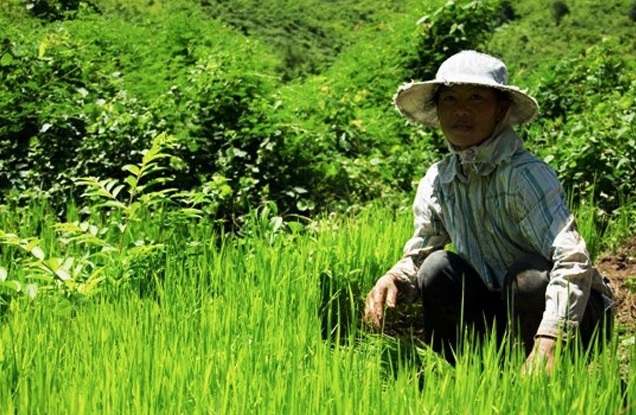
- Rice production: to enhance rice production, the aim is to expand the rice plantation area to between 900,000 and 950,000 hectares in order to achieve the targeted rice yield of 3.5 to 4.0 tons annually.
- Food crops production: aim to expand food crops production in areas of 261,710 hectares, with the production target of 2.12 million tons
- Livestock and fishery: aim to increase meat, eggs, and fish production up to 577,000 tons to meet the consumption target of 73 kg/person/year
- Agricultural Commodity Program:
- Agricultural commodity production: aim to achieve an export target of 15 million tons, which is projected to generate an annual export value of approximately 6 billion USD.
- Livestock, fishery promotion: aim to produce cows for exporting to China, with a target of 50,000 cows annually, generating an export value of approximately 0.5 billion USD.
- Forestry Management and Protection Program
- Dedicate efforts to conserve the forestland covering 70 % of the total area of the country;
- Enhance the forest cover to not less than 70% of the total country area;
- Upgrade conservation forests (protected areas) to national park status (with a target of establishing five national parks);
- Undertake forest regeneration, aiming at achieve a target of 1.8 million ha, alongside the establishment of tree plantations for commercial purposes, with a target of 200,000 hectares to support the domestic industry.
- Rural Development and Poverty Eradication Program
- Dedicate effort to bring 204,360 families over the poverty line across the country; elevate 3,104 villages and 69 districts from below-poverty-line status across the country;
- Dedicate effort to have 4,420 villages declared as developed villages
Lessons and Challenges
- Lessons:
- The translation of Party and Government guidance into specific, actionable programs and projects is essential for achieving sectoral goals;
- Strong enforcement of laws and regulations is crucial to enhance effective management of the sector;
- The development of basic infrastructures, human resources, and substantial investment is pivotal to boosting food production and exporting commodity products;
- Promoting a common understanding in alignment with new inclusive rural development guidance is necessary to foster collaboration;
- Deploying technical staff to support local communities is vital for improving local production capabilities;
- Strengthening farmer groups serves as the foundation for successful agricultural commodity production.
- Challenges:
- The agricultural sector requires substantial advancements (such as agricultural processing) production to achieve industrialization and modernization;
- There is a need to standardize irrigated areas and ensure the comprehensive allocation and zoning of agricultural land.
- The current services of the agricultural technical service centers and facilities are insufficient.
- The regulation of commercial tree plantations remains insufficient;
- Efforts to elevate poor families, villages, and districts have not met expected targets; and
- The allocation of resources such as domestic funds, grants, loans, and bank credit for sectoral development remains limited, presenting significant obstacles to the sector’s growth and potential.
Other sectors’ support is necessary to:
- Enhance Food Security and Nutrition: collaboration with Transportation Sector and Health Sector can improve the distribution of agricultural products, ensuring that food reaches urban areas and also promote better nutrition, food safety practices, and emergency responses
- Promote Sustainable Practices: collaboration with Natural Resource and Environment Sector can assist in implementing sustainable farming practices, helping to preserve natural resources and biodiversity
- Improve Infrastructure: support from the Infrastructure Sector can lead to better irrigation systems and roads, which are important for agricultural productivity
- Facilitate Research and Development: partnership with Education Sector can lead to building up sufficient skilled labor/technical and innovations relevant to better farming techniques
- Increase market access: collaboration with private sectors can improve agricultural product value chain and help farmers reach broader markets, both domestically and internationally, increasing their income and sustainability
- Strengthen policy frameworks: collaboration with governmental and non-governmental organizations can lead to better policies, supporting agricultural development and famer welfare.
By promoting more inter-sectoral collaboration, this can create a more resilient and productive agricultural sector that contributes to the overall economic development of the country.
Local authorities’ support in community mobilization and sub-national levels’ (provinces and districts) contribution in implementing priority programmes are important.
Support Needed
In order to ensure the sectoral growth rate at 2.5% per year, contributing 15.3% of the GDP, the investment requirement is estimated about 23,375 million USD. Of these, the details of investment are as follows:
From the Government:
- Approximately 250 million USD (Public Investment Program ‘PIP’), equivalent 1.07%
From Development Partners:
- Approximately 3,125 million USD (Official Development Assistance ‘ODA’), equivalent to 13.37%
From Private Sectors:
- Approximately 20,000 million USD (Foreign Direct Investment ‘FDI’), equivalent to 85.56%
Sub-Sector Working Groups
The Sector Working Group includes 6 Sub-Sector Working Groups and 1 Policy Think Tank:
- Sub-Sector Working Group on Farmers and Agribusiness (SSWG-FAB): chaired by the Department of Agriculture Extension and Cooperatives and co-chaired by the Swiss Agency for Development and Cooperation (SDC) to Laos;
- Sub-Sector Working Group on Agricultural Biodiversity (SSWG-ABD): chaired by the National Agriculture and Forestry Research Institute and co-chaired by the Food and Agriculture Organization (FAO) to Laos;
- Sub-Sector Working Group on Forestry (SSWG-F): chaired by the Department of Forestry and co-chaired by Japan International Cooperation Agency (JICA) to Laos;
- Sub-Sector Working Group on Rural Development (SSWG-RD): chaired by the Department of Rural Development and co-chaired by the Representative of Luxembourg Embassy to Laos;
- Sub-Sector Working Group on Irrigation (SSWG-I): chaired by the Department of Irrigation and co-chaired by the Asian Development Bank (ADB) to Laos;
- Sub-Sector Working Group on Agroecology (SSWG-AE): chaired by the Department of Agricultural Land Management and co-chaired by the Agency for French Development (AFD);
- In addition, there is a Policy Think Tank (PTT) under the guidance of the National Agriculture and Forestry Research Institute, which is responsible for agricultural policy researches.
SWG Secretariat Contacts
- PhD Boundeth Southavilay, Director General, Department of Planning and Cooperation, Ministry of Agriculture and Forestry, Tel: 021 415363
- PhD Phommy Inthichack, Deputy Director General, Department of Planning and Cooperation, Ministry of Agriculture and Forestry, Tel: 021 415363
1. Midterm Report of the implementation of 9th Five-year Agriculture, Forestry, and Rural Development Plan (2021-2025), Ref No. 4530/MAF, dated 8th Nov 2023 (report for 2021 to 2022).
2. The 9th five-year Agriculture, Forestry, and Rural Development Plan (2021-2025), Ref No. 0303/MAF, dated 03 June 2021 (Page 28-36)
3. The 9th five-year Agriculture, Forestry, and Rural Development Plan (2021-2025), Ref No. 0303/MAF, dated 03 June 2021 (Page 49)